
Symptom
Perimenopause headaches: why they change
Headaches and migraine often get worse in perimenopause, and the reason is well understood. A fall in oestrogen is a recognised migraine trigger, which is why migraine attacks cluster around the drop before a period. Perimenopause makes those falls frequent and unpredictable, so the trigger fires more often and with less warning.
Free. No email required. No signup required. Takes about 2 minutes. Scored entirely in your browser: your answers are never stored or sent anywhere. Your score is shown next to the average for your age band.
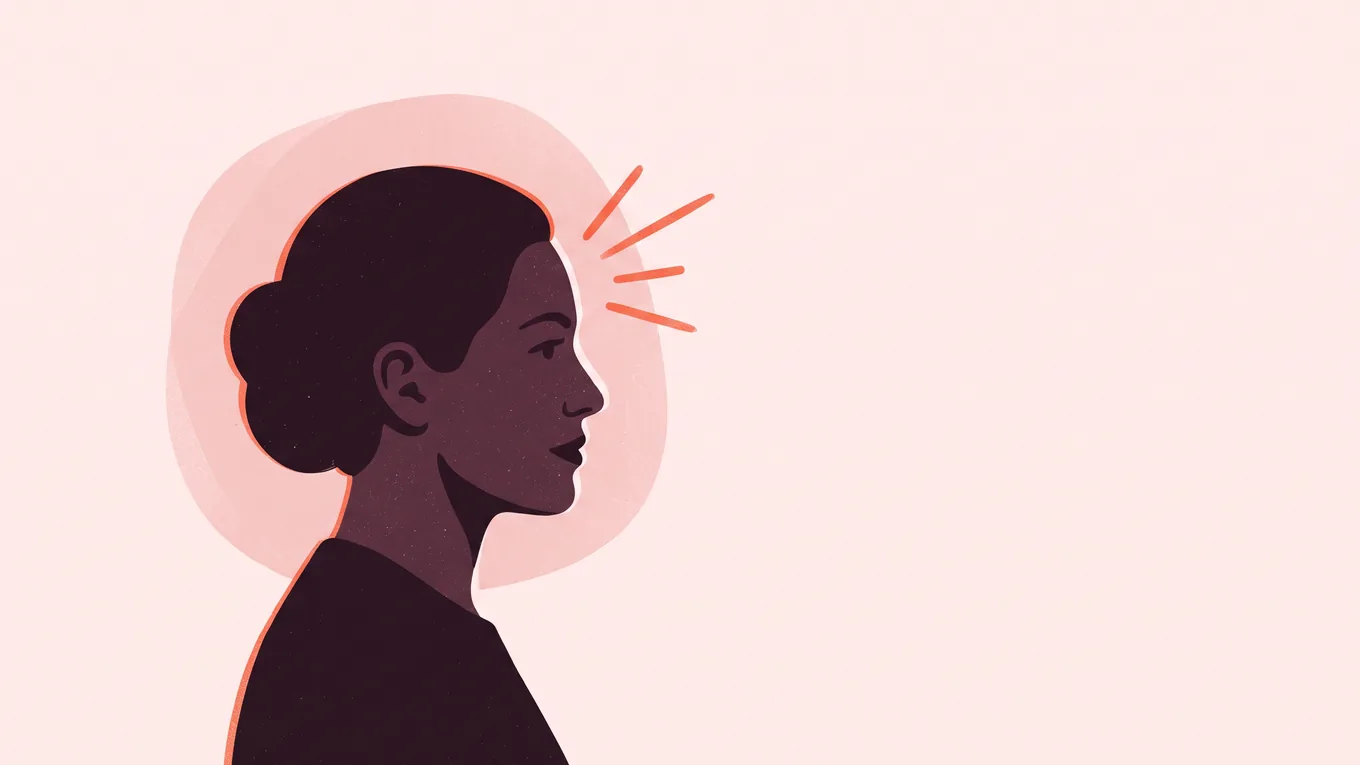
Why perimenopause makes headaches worse
Migraine responds to oestrogen withdrawal rather than to oestrogen being low. That distinction explains a lot. Women with menstrual migraine get attacks in the days around their period, when oestrogen drops sharply, and often have far fewer during pregnancy, when levels are high and stable.
Perimenopause is a long run of unpredictable oestrogen. Levels swing up and down rather than declining smoothly, so the withdrawal that used to happen once a month on a schedule can now happen at unfamiliar intervals. People describe attacks arriving without the warning they had learned to read, and a pattern they had managed for twenty years no longer holding.
There is a reasonably hopeful end to this. Migraine that is driven by hormonal fluctuation often settles once the fluctuation stops, which is to say after the final period rather than during the transition. That is a general tendency, not a promise, and it does not help much in the years when it is at its worst.
Which kind of headache is which
| Type | What it tends to feel like |
|---|---|
| Migraine without aura | Throbbing, often one sided, moderate to severe, worse with movement, frequently with nausea and dislike of light or sound. Hours to days. |
| Migraine with aura | The same, preceded by reversible neurological symptoms, most often visual: zigzags, blind spots, shimmering. Usually building over minutes and lasting under an hour. |
| Tension-type headache | Pressing or tightening on both sides, mild to moderate, not worsened by routine activity, without nausea. |
| Medication-overuse headache | A headache present most days that developed while taking painkillers or triptans frequently. It improves only when the medication is reduced, with support. |
Sleep disruption and hot flushes make every kind worse, so treating those sometimes does more for the headaches than treating the headaches.
The one thing to raise before any hormone decision
If you get migraine with aura, say so before starting or continuing combined hormonal contraception, meaning any pill, patch or ring containing oestrogen. Migraine with aura is associated with a raised risk of ischaemic stroke, and combined hormonal contraception raises it further. This affects which contraception is appropriate, and it is a standard part of the conversation rather than an obscure one.
This matters in perimenopause specifically because contraception is still needed and is often used to manage bleeding at the same time. Aura can also appear for the first time in midlife, so it is worth mentioning even if it was never relevant before. Hormone therapy for menopausal symptoms is assessed differently from contraception; that is a conversation for a clinician who knows your history.
What helps
- Keep a diary that includes your cycleAttack dates against period dates is the single most useful thing you can bring. A hormonal pattern is treatable in ways a random one is not, and it is invisible without the record.
- Protect sleep firstNight sweats fragment sleep, and fragmented sleep lowers the migraine threshold. Treating the vasomotor symptoms sometimes reduces the headaches by itself.
- Watch painkiller frequencyRegular use of acute painkillers or triptans on more days than not can produce medication-overuse headache, which then looks like worsening migraine. Counting the days you medicate is worth doing.
- Ask about prevention, not just reliefIf attacks are frequent, preventive treatment exists and is a different conversation from what to take during an attack.
If the headaches arrived alongside cycle changes, it is worth knowing where you sit overall. Our check scores nineteen symptoms and places your cycle pattern against the STRAW+10 stages.
When a headache needs urgent attention
Seek urgent medical help for a headache that comes on suddenly and severely, reaching its worst within a minute or two; a headache with fever, neck stiffness or a rash; a headache with weakness, numbness, confusion, difficulty speaking or visual loss that does not resolve; a headache after a head injury; or a headache that is consistently worse when lying down, coughing or straining.
Also see someone, less urgently, for a headache that is new or clearly different from your usual pattern, particularly after 50. None of this routes anywhere commercial.
Sources
- National Institute for Health and Care Excellence. Menopause: identification and management. NICE guideline NG23, published November 2015, last updated November 2024. Recommendation 1.2.2 lists the symptoms commonly associated with menopause.
- Harlow SD, Gass M, Hall JE, et al. Executive summary of the Stages of Reproductive Aging Workshop +10: addressing the unfinished agenda of staging reproductive aging. Menopause 2012;19(4):387 to 395.
Common questions
Can perimenopause cause headaches?
It can make existing migraine considerably worse and can bring on headaches in women who had few before. The mechanism is oestrogen withdrawal, a recognised migraine trigger. In perimenopause oestrogen swings unpredictably rather than declining smoothly, so the trigger fires more often and at less predictable times.
Why do I suddenly get migraines in my 40s?
Because the hormonal pattern changed. Migraine responds to falls in oestrogen rather than to low oestrogen, and perimenopause replaces one predictable monthly fall with frequent irregular ones. Disrupted sleep from night sweats lowers the threshold further. New or clearly different headaches are still worth having assessed rather than assumed.
Do perimenopause headaches go away?
Migraine driven by hormonal fluctuation often settles once the fluctuation stops, which happens after the final period rather than during the transition. That is a tendency rather than a guarantee, and it is not much comfort during the years when attacks are most frequent. Preventive treatment exists for that period.
Is migraine with aura dangerous in perimenopause?
Migraine with aura is associated with a raised risk of ischaemic stroke, and combined hormonal contraception containing oestrogen raises that risk further. This makes it important to tell a clinician about aura before starting or continuing a combined pill, patch or ring. Aura can appear for the first time in midlife, so mention it even if it is new.
What helps perimenopause headaches?
Keeping a diary of attacks against cycle dates, so a hormonal pattern becomes visible and treatable. Protecting sleep, since night sweats fragment it and fragmented sleep lowers the migraine threshold. Watching how many days a month you take acute painkillers, because frequent use can cause medication-overuse headache. And asking about preventive treatment if attacks are frequent.
Keep going
 The 2-minute perimenopause checkNineteen scored symptoms, your stage, and a printable doctor summary. Free, no email.
 Muscle aches and joint painRecognised in national guidance. The mechanism, what to rule out, and what helps.
 Dry eyes in perimenopauseWhy the tear film destabilises, why dry eyes water, and what actually helps.
 The stages of menopauseEvery STRAW+10 stage, what defines it, and where perimenopause starts and ends.
One symptom is not the picture
A single symptom says very little on its own. Scored alongside fifteen others and your cycle pattern, it becomes something a clinician can act on.
You are not imagining it, and it is not too small to mention.
Take the 2-minute checkFree, no email, no signup. Scored entirely in your browser. Screening, not diagnosis.